Learning Styles
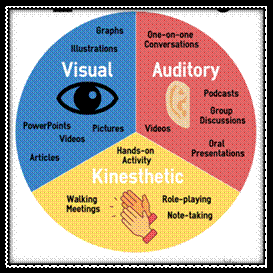
|
1.
Visual/Spatial 2.
Aural/Auditory 3.
Verbal/Linguist 4.
Physical/Kinesthetic 5.
Logical/Mathematical 6.
Social/Interpersonal 7.
Solitary/Intrapersonal |
|
|
|
There is
no wrong way to learn. Play to your strengths when trying to learn new concepts
so that it really sticks. If knowledge is presented in oral form and you
learn visually, draw pictures to represent the ideas. If you learn well
through social interaction, schedule a study group with others to strengthen
your learning. |
|
|
|
|
|
VISUAL / SPATIAL Refers to learners that learn best when
they have an image or cue to help them process the information. CHARACTERISTICS o
They easily visualize plans and outcomes. o
They have a good sense of direction, and therefore do not
get lost easily. o
They like coloring, drawing. |
|
|
|
AURAL / AUDITORY Refers to learners who respond primarily to
sound. Most musicians are aural learners, but many others are well. Traditionally, African culture has been
highly aural; many scholars maintain that it is still predisposed toward oral
methods. CHARACTERISTICS o
Enjoy listening to music in the background while learning o
Have a good sense of pitch or rhythm o
Uses rhythms to remember something o
Find it easy to memorize from oral presentation |
|
|
|
Verbal / Linguistic o
Learners who retain information under verbal instruction and
writing. o
Typically they go into public speaking, writing journalism and
debating CHARACTERISTICS o
They enjoy reading and writing o
They express themselves both in writing and spoken words easily o
They like tongue twisters and rhymes o
Enjoy learning new words |
|
|
|
Physical / Kinesthetic o
Learners through the motions accompanying what is being taught. o
Physical learners are extremely animated. CHARACTERISTICS o
They easily notice the physical world around them e.g. textures o
Enjoy sports and outdoor activities o
Enjoy working with their hands o
They use body language o
Enjoy making models or jigsaw puzzles |
|
|
|
Mathematical / Logical o
Learners who want to understand the reason behind what is being
explained. o
They are often end up being engineers or accountants. CHARACTERISTICS o
They like games like chess and doing brainteasers o
Enjoy classifying information together o
Perform complex calculations o
Create procedures for future use o
Plan agendas and itineraries |
|
|
|
Social / Interpersonal o
These are individual who learn easily through extra-curriculum
activities. o
They are involved in teamwork. CHARACTERISTICS o
Prefer to socialize after work. o
Enjoy playing group sports o
Bounce ideas off of other, thus getting a feedback o
Listen well o
They are often trusted by others o
Usually, it is learning style for extroverts. |
|
|
|
Solitary / Intrapersonal o
Individual who prefer to learn on their own o
They keep to themselves. o
It is usually learning for introverts. CHARACTERISTICS o
Spend time of self-analysis o
Prefer to relax away from crowds o
They think independently o
Records personal thoughts and events as a way to measure
improvement. |
|
|
|
There is
no wrong way to learn. Play to your strengths when trying to learn new
concepts so that it really sticks. If knowledge is presented in oral form and
you learn visually, draw pictures to represent the ideas. If you learn well
through social interaction, schedule a study group with others to strengthen
your learning. |
|
|
|
Learning styles exercise •
Create a list of these intelligences, but define them in your
own words. •
Identify your personal learning strength. You might find you
employ several. You might also realize that you do not enjoy learning in
certain ways. •
For each intelligence, create a picture as a mnemonic device. |
|
|
|
|