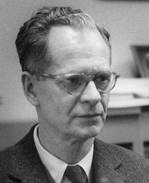
Skinner
|
|
Burrhus Frederic Skinner (March 20, 1904 – August 18,
1990) was an American psychologist, behaviorist,
author, inventor, and social philosopher. He was a professor of
psychology at Harvard University from 1958 until his
retirement in 1974. 1.
Operational conditioning. An outgrowth from Pavlov’s classical
conditioning, operational conditioning states that 2.
Associative conditioning. He noted that teachers can teach children
to associated bad consequences with certain actions. Skinner
considered free
will to be an illusion. He believed human action is dependent on
consequences of previous actions. His theory emphasized the principle of reinforcement:
1.
If the consequences to an action are bad, there is a high chance
the action will not be repeated; 2.
If the consequences are good, the probability of the action
being repeated becomes stronger. Skinner
developed behavior analysis, especially the
philosophy of radical behaviorism,[8]
and founded the experimental analysis of behavior,
a school of experimental research psychology. He also used operant conditioning to strengthen behavior,
considering the rate of response to be the most effective
measure of response strength. To study operant conditioning, he invented the operant conditioning chamber (aka
the Skinner Box),[7]
and to measure rate he invented the cumulative recorder. Using these tools,
he and Charles Ferster
produced Skinner's most influential experimental work, outlined in their book
Schedules of Reinforcement (1957).[9][10]
From
Wikipedia (Full
Wikipedia article) |
|
|
|
|
|
|