|
|
Information
Processing |
|
Teachers must help students get information
into their long term memory. What are some ways to get things into long term
memory? How can students think about things to keep them in long term memory?
Using “Mnemonic devices” can be helpful. Utilizing “prior knowledge” is also
an important element in developing long term memory. |
|
|
Memory 1.
Immediate
memory = in and out 2.
Short term
memory = 15-30 seconds 3.
Long term
memory = Some
memory/learning devices 1.
Make up a story
which includes the details of the desired knowledge. 2.
Use “chunking”
– i.e., grouping things together (e.g., grouping telephone numbers). 3.
Create acronyms
(first letters of a series of words) a.
Shopping list =
vegetables, eggs, milk = VEM 4.
Write things
down. Because writing is a tactile activity, people tend to remember
knowledge longer if they have done a physical activity. 5.
Draw a picture. 6.
Create a poem
or song. 7.
Heirarchical learning 8.
Concept maps 9.
Mnemonic
devices Prior
knowledge and long term learning Heirarchical devices Visual
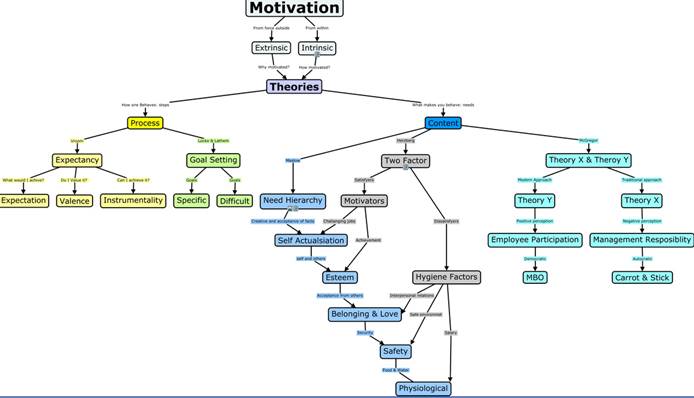
learners versus auditory learners Concept maps See: https://ctl.byu.edu/tip/concept-mapping Example of a concept map
related to “Motivation”
False Memory Dr.
Loftless did experiments “false memory” research. Several examples: 1.
Using “smashed”
vs. “hit” predisposed listeners to create a false memory of the speed of a
vehicle collision. 2.
Creating a
false memory about getting lost in a shopping mall. If people reinforce such
a false memory with supporting details (details which are actually false).
This illustrates the power that people have to create false memories in other
people by repeating something or falsely elaborating on a story. 3.
Might
politicians be able to use this idea to spread false knowledge or false
memories to advance their personal political goals. 4.
|
|